Owning the data layer: the offshore path to UK AI sovereignty
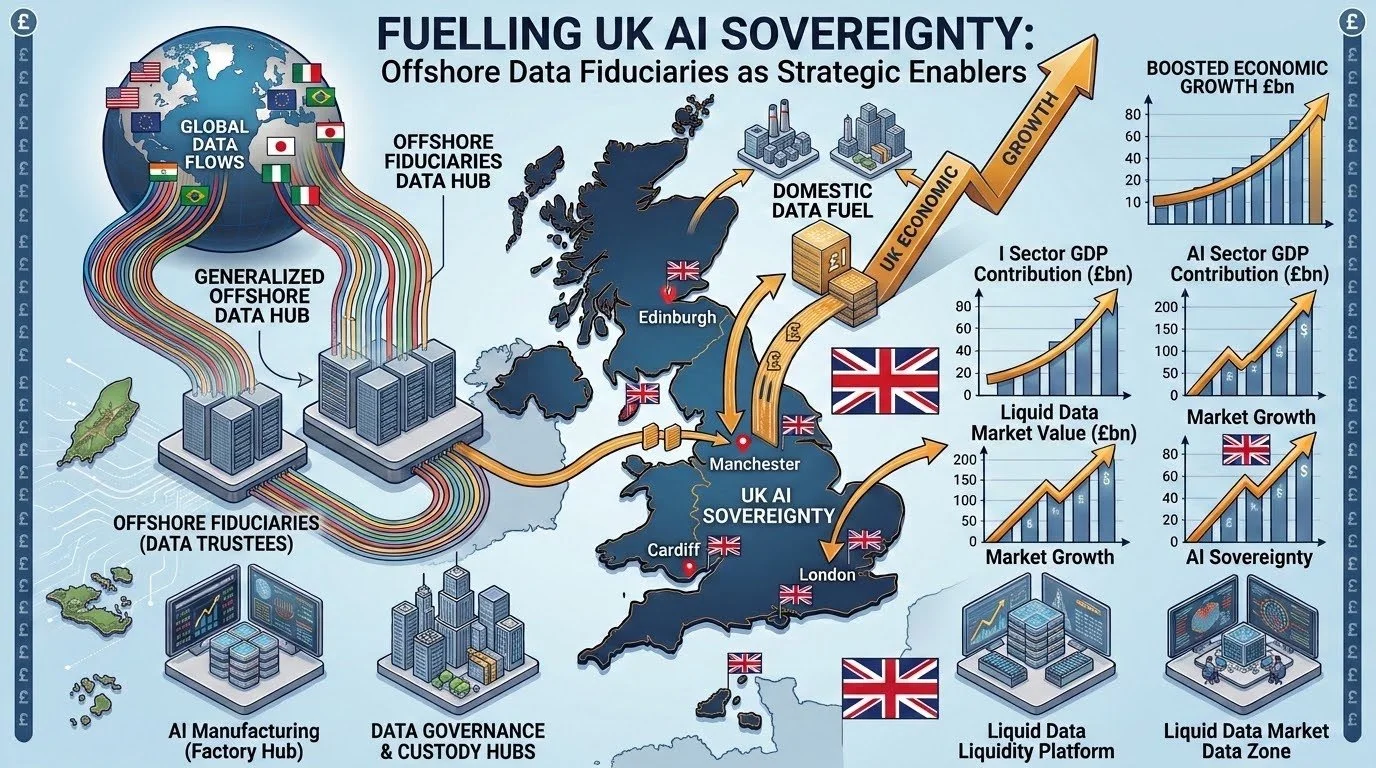
Tldr: The CDOT jurisdictions are spaces of regulatory innovation. This is a strategic advantage to the UK’s AI ambitions. AI power has 4 levels - compute, energy, data, and law. By using the CDOTs to experiment with new data management and asset-holding laws, the UK can boost its AI industry and assert global influence.
It is an observation so commonplace as to be almost trite: AI is transforming the world. Far from trite, however, are the many and spiralling consequences that emerge from the increasing power of AI systems - vast economic change, vertiginous concentrations of power and capital, and a complete realignment of geopolitics. Even on the more conservative assumption, every element of life is due to be affected - and the power of AI models keep accelerating. On the less conservative assumptions, foundation models will soon be akin to a ‘country of geniuses in data centres’. Even in the best case scenarios - those of a well managed transition, where the bulk of citizens continue to live lives of prosperity, security, and meaningful occupation, and where this happy state is somehow shared in places outside of China and the USA - AI is coming for our jobs. Because it is coming for our jobs, it is also coming for the tax base of states, and the basic presumptions upon which society is currently organised. For today's governing elites, failure to recognise this is a terrifying abdication of imagination and responsibility.
Middle powers face choices - choices about how and where to secure enduring leverage in the era of artificial intelligence. By many measures, the UK is the 3rd most important country in AI - but it is a distant third, and one above all undermined by its failure to develop domestic compute capacity. To engender defensible economic value, the UK - like other middle powers - must look to use to its every advantage. Two of these are entirely under-appreciated - the global reach of the common law, and the offshore acceleration zones of the CDOTs.
AI relies on compute infrastructure, energy capacity, and data. It also relies on the intangible - the laws and software through which data is acquired, models are trained, agents act, and companies interact. The creation of data rights, data assets, and data fiduciaries is a core way that Britain can :
create wealth for its citizens,
protect their interests,
Boost the economy through data access
export services internationally through the AI transition
Gain international rule-shaping power
It can do so using the speed, nimbleness, and flexibility of its offshore jurisdictions.
1. The UK AI industry
To understand why and how data fiduciaries and offshore data fiduciaries are a boon to the UK’s AI strategy, we must look at three areas - the current state of the UK AI industry, the basis of AI itself, and where value sits in AI.
Where value sits in AI
Before turning to Britain's own choices, it is worth asking a more fundamental question: where does value sit in the AI stack? The top layer is in AI-enabled applications - apps like Legora or Sierra. These AI applications rest on three scarce inputs and one layer that determines whether those inputs can be turned into anything ownable at all. Each is a site of potential leverage or dependency for the states that don't control it.
Compute: The chips and clusters that turn data into a trained model, and provide inference capability. It is scarce because it is expensive, physically constrained by fabrication capacity, and currently concentrated among a handful of firms and, increasingly, a handful of states with the sovereign capital to buy their way in.
Energy: Without energy, the computers don’t work. A training run or an inference cluster is, as much as anything, an extraordinarily large electricity bill. As models grow, the binding constraint shifts from whether a country can acquire the chips to whether it can get power to them - grid connection and generation capacity move from afterthought to gating factor.
Data: The fuel for training and the basis for ongoing inference. As later sections set out, the version of that fuel that was free and easy to scrape is running out. What remains valuable is increasingly the data that was never on the open internet in the first place: locked inside institutions, devices, and private lives.
Law, and the ontological frameworks beneath it: the layer that determines whether the other three can be turned into anything at all. It defines what companies are, and how we interact with them; it defines what data is, who owns it, and what can be done with it. Someone must decide what a given piece of data is, who has the right to use it, and on what terms - and that decision, once encoded into contracts, licences, and eventually into the technical pipelines that move data around, becomes a form of infrastructure in its own right. Compute and energy are physical constraints, data is a supply constraint, and law is the mechanism that converts the other three into something usable, ownable, licensable, and enforceable - sitting over them, not beside them.
AI training has relied on a cavalier attitude to copyright enforcement, something now challenged by court rulings. But training is only a part of the story. Most of the time, models use data after training, at inference: retrieval-augmented generation pulling live documents into a context window, agents querying external databases and APIs mid-task, models drawing on data that was never part of the original training run at all. That is a continuous question, not a one-off one - is this access still licensed, is this specific use within scope, has consent since been withdrawn, is a fee owed for this particular call - and it cannot be answered once by a training-time settlement. It has to be checked at the point of use, every time, which is precisely what turns "law" from a static contractual fact into something that has to be built as live infrastructure: encoded into the pipelines that actually mediate access, not just filed away in a licence agreement. It is here that the CDOT jurisdictions - through legal innovation, flexible laws, and fiduciary expertise - can give Britain advantage.
The UK AI industry
Britain is the third-largest AI market in the world, home to Google DeepMind, ARM and Wayve. AI startups raised $12.6 billion in h1 2026; overall, The UK attracted 39% of all European VC investment during the period and raised more funding than the next three largest European markets combined. The AI Opportunities Action Plan has stood up a Sovereign AI Unit backed with up to £500 million, designated five AI Growth Zones, and launched the Isambard-AI supercomputer at Bristol alongside a sixfold expansion of Cambridge's DAWN facility. Britain also holds non-material advantages: through institutions such as the AI Security Institute, it is a leading voice on AI safety and governance.
Set against this, UK positioning is weak in three areas: compute capacity, energy supply, and a lack of control over any foundation model of its own. The UK could, in principle, host 100 application-layer decacorns while owning almost none of the infrastructure underneath them - an AI application leader, but not an AI power, with no ability to prioritise domestic workloads in a crunch and little say over the terms on which the underlying models are trained or governed. The numbers bear this out: the US and China host90% of the world's top AI superclusters, and and while the UK ranks 4th globally in datacentre capacity - floor space, racks, physical sites - it holds only around 3% of global compute power, the actual chip-driven processing capability that determines what can be trained or run. Real infrastructure, but the wrong shape for frontier training. Energy compounds this:a third of UK organisations are already evaluating other countries for AI workloads because of grid limits, with power availability now a bigger constraint on scaling than talent or regulation.
The UK is attempting to address its weaknesses in compute and power. However, almost nothing has been said about data, and nothing at all about the legal layer that determines who gets to own and enforce a claim on it - the largest and fastest-growing asset Britain has not yet touched, and the one a middle power can still plausibly turn into leverage. That is where the remainder of this piece is concerned.
The role of data in creating value across the economy
There are 4 great problems with data: valuation, access, liquidity, and value redistribution. Each of these provides opportunities for the UK to gain economic and social advantages through the CDOTs.
Data value: we know it's there, but can’t say what it is
Everyone agrees data is valuable. Almost nobody can say how valuable, and the people whose job it is to put a number of things - accountants and economists - are both, for structurally different reasons, currently unable to.
We begin with the accountants. Data meets the formal definition of an intangible asset used by IFRS and GAAP: a non-physical resource expected to generate future economic benefit, the same category patents, trademarks and goodwill sit in. But accounting rules only allow an intangible to be capitalised on a balance sheet if it was acquired - bought from someone else, with a price attached - not if it was generated internally, which is how almost all corporate data comes into existence. The IMF has said a transparent mechanism for valuing data is urgently needed. Nobody has quite built one.
The economists have a parallel problem, on the other side of the ledger. GDP only counts things that are bought and sold at a price. A huge amount of the value data generated today flows through products that are free at the point of use - search, maps, social media, increasingly AI tools themselves - which means, officially, that value shows up in national accounts as precisely zero. Economists have proposed workarounds, but none of these has been adopted into how any government actually measures its economy. The consequence is that policymakers are, by their own official statistics, mostly blind to how much value data-driven activity is actually creating.
This matters well beyond AI. Data underpins personalisation, drug discovery, fraud detection, logistics, and much else besides. None of that shows up cleanly on a balance sheet or in GDP, which means the economy has been quietly running on an asset class it has no reliable way to price. AI has not created this problem; it has simply made it impossible to keep ignoring, because AI is the first technology to put an explicit commercial price - a licence fee, a royalty, a lawsuit settlement - on data that was previously valuable in only a vague, unmeasured way. Nobody can say precisely how valuable data is.
Data access: needed to train AI & robots
The problem of data access is twofold. The first is that the free internet that trained the first generations of large language models is running out. Epoch AI, which tracks scaling constraints, projects with 80% confidence that the stock of publicly available human-generated text will be fully used somewhere between 2026 and 2032. Synthetic data helps, but it is a supplement, not a substitute — particularly in sensitive fields such as healthcare and finance, where synthetic data still needs something real to validate against. This is the moment training stopped being able to rely on data nobody had to pay for.
The second issue arises in the new areas of AI. As AI moves into robotics, augmented reality and healthcare, developers increasingly need data that was never on the open internet to begin with - drone imagery, fitness-tracker logs, enterprise telemetry — data sitting behind genuine walls of ownership, consent, and technical formatting rather than simply uncrawled. This scarcity is what is driving the shift from flat licensing fees toward live, usage-metered access deals, which have grown from a handful in 2023 to dozens disclosed publicly by 2026. Data scarcity was once a researcher's problem. It is now a boardroom problem, and — increasingly - a legal one, which is precisely where a middle power's comparative advantage in law rather than raw compute becomes strategically relevant.
Data liquidity: small and inefficient data markets
Data is insufficiently liquid, and the problem predates AI by decades - AI has simply made it visible and urgent, because it is now the largest and highest-profile buyer in a market that was already thin. Insurers, hedge funds, market researchers, retailers and pharmaceutical companies have all been licensing and trading data for years; the structural problems below apply to all of them, not to AI labs specifically. As a result, the market is smaller than it might be, and less efficient.
The clearest problem is that almost every deal is bespoke. There is no standardised venue where a data licence can be benchmarked against comparable agreements or resold to a third party — each negotiation starts from scratch, with its own lawyers and its own terms. Confidentiality clauses mean that even where a headline price does leak out, these are the exception rather than a reliable market signal, and there is still no mechanism producing a market-clearing price the way an exchange does for a stock or a commodity.
It also, plausibly, rations access to the market by size. Only organisations with the legal and commercial capacity to run a full bespoke negotiation - a large publisher, an established data vendor, a well-resourced research institution - have historically been able to strike these deals. A smaller archive, a regional dataset, or an individual generating valuable data has had comparatively little practical route to the same table, since the fixed cost of a one-off negotiation is high relative to what a smaller holder has to offer. This is an inference from how the market visibly behaves rather than something independently measured, but it fits the pattern of who actually appears on both sides of every disclosed deal.
The harder claim to get right is collateral, because the obvious comparison - royalties - actually cuts the other way. It is not that data-derived income can never be collateral - it demonstrably can be, and has been for a century in the entertainment industry. The issue is that current, ad hoc data licences lack the specific structure that made royalties financeable: a standardising institution, decades of comparable transactions, a durable and predictable income stream, and clear, registered title. The economics are the same as a royalty. The structure isn't — and that structural gap, not anything inherent to data itself, is what is keeping it illiquid.
Value redistribution
Individuals see remarkably little financial benefit from their own data. They receive better products and services in exchange for it, which is real value - but the underlying data, the raw material every downstream data-driven system is built on, is not something they own in any enforceable sense. It can be collected, pooled, licensed and monetised by whoever has the technical means to do so, while the person who generated it holds no capital stake in what that generates.
This has always been a social and economic problem, but AI has raised its visibility considerably. As AI increasingly substitutes for at least some forms of wage-based work, the data people generate and the ongoing feedback they provide could become a more significant, and more durable, source of economic contribution than it was before. A capital-like claim on data offers one plausible mechanism, among others being discussed elsewhere, for connecting ordinary people's economic interest to a transition that otherwise has little built-in incentive to include them.
The mechanism to achieve this has been missing. A legal form capable of holding a genuine, enforceable claim on someone's data, and returning value to them as that data is used rather than once, upfront, and never again, has simply never existed at scale. That mechanism - a fiduciary structure paying out royalties on an ongoing basis, similar in kind to a resource royalty trust or a music collecting society - is what the remainder of this piece sets out in practical terms.
The assetization of data: a solution
Creating data assets
If accountants and economists cannot agree on data's value in the abstract, the practical answer is not to keep arguing in theory but to create the conditions under which a real price can be discovered in practice: define who owns a piece of data, give them a mechanism to license it, and let a buyer's willingness to pay do the work no accounting standard or GDP methodology currently can. Assetization does not resolve the theoretical valuation debate; it sidesteps it, and it does so by generating the one thing theory cannot - an actual transaction.
To "assetize" data, concretely, is to give it the features that make anything investable: a defined beneficial interest, a licensing mechanism, a revenue stream, and a legal owner able to enforce the terms. There is already a commercial appetite - the market for prepared, licensed AI training data (annotation, curation, synthetic and licensed datasets) is estimated at roughly $3–7 billion today to between $16 billion and $50 billion-plus by the early 2030s depending on methodology. But these figures capture only data that is already being licensed. The far larger prize is the long tail of personal, behavioural and enterprise data that nobody owns in any legally meaningful sense at all - which means the true opportunity in assetization is absent from every market-research report, because the market for it does not yet exist. That absence is not grounds for caution. It is the entirety of the opportunity.
There are two paths towards the assetization of data. Both are being being explored in the CDOTs.
Data assets as flow: One approach assetizes a flow: a claim on access as it happens, priced and paid each time the data is drawn on, in the way a resource royalty trust does not trade barrels of oil but trades a claim on revenue as oil is extracted. Value here only appears at the point of use - a training run pulling from the data, an inference call retrieving from it - so what is actually held is a right to meter and be paid on an ongoing draw, not a static stockpile. This is the approach being tried in Jersey.
Data assets as the database: The other approach assetizes the stock itself: a bounded, curated dataset registered as a defined piece of property, much as a patent sits on a balance sheet - the ability to license data flows is then simply one of several things ownership of that registered asset confers, alongside collateralisation and straightforward balance-sheet recognition. This is the approach taken by the Isle of Man.
Neither is more "correct" than the other, and different data will suit different treatment - a continuous stream of personal sensor readings looks more like a flow, a discrete institutional archive looks more like a stock. But the distinction matters practically for the flow model specifically: a claim on an access flow is only worth its full value if usage is tracked with reasonable fidelity - the more precisely each draw is recorded and attributed at the point of use, the more defensibly it can be priced and paid. A one-off licence needs none of this; it is priced once and settled, and for many transactions that will be the right and sufficient outcome. Metering only becomes necessary once payment is meant to track ongoing, variable use rather than a single upfront sum - which is precisely the case, set out earlier, of AI's shift toward continuous, inference-time access.
The opportunity
Assetizing data makes it licensable
The data now valuable to AI developers is not absent - it is locked inside institutions, devices and private lives, blocked not by scarcity but by the lack of a mechanism to license it. A defined beneficial interest and a legal owner able to enforce terms is precisely that mechanism: it is what turns an NHS trust's patient data or a million individuals' fitness-tracker logs from data nobody can touch into data that can be licensed on defined terms. Assetization is, in effect, the UK's supply-side answer to data scarcity - not more scraping, but bringing the walled-off tranche of data into a form AI developers can legitimately draw on.
Assetizing data makes it liquid
Illiquidity is caused by a structural absence - no standardising institution, no comparable transactions, no registered title - not a defect in data itself. A data fiduciary, managing a data asset, supplies exactly this: registered legal title held by the trustee, a standardising institutional form, and, as more assets are licensed through comparable structures, a growing body of comparable transactions to benchmark against. Liquidity does not follow automatically from assetization, but it becomes possible for the first time - data-backed lending, resale, and benchmarking all presuppose the asset assetization creates.
Assetization enables redistribution
By turning data and data flows into property, data assetization means individuals can be compensated for their data. A beneficial interest is a capital stake: not a one-off payment for use, but an ongoing, transferable, legally enforceable claim on a flow of income. That is the same shift that once turned "musicians should be paid when their song is played" from a grievance into a collecting society. Assetization performs the equivalent conversion for data - from a moral claim into a financial instrument
Opening up datasets - and returning value to those who generate it
The UK is already taking steps to open up data. What it needs, however, is to (a) develop mechanisms for the assetization of data and (b) develop more ways for that data to be structured and managed.
Data access, smart data, and the national data library
The National Data Library: Nobody in Whitehall can state precisely what a National Data Library is worth in pounds, any more than an accountant can price a company's customer database - but the case for building one has never rested on precise valuation. It rests on directional confidence: AI developers are visibly paying real money for licensed data, other countries are visibly building similar institutions, and the cost of moving early and being wrong about the exact number is far smaller than the cost of waiting for a settled valuation methodology that may never arrive while the underlying asset keeps being used, priced and fought over regardless. That is the logic behind the National Data Library and the Smart Data programme: not certainty about value, but confidence that the value is large enough, and the window to shape how it gets captured narrow enough, that acting now beats waiting for economists and accountants to agree on a number they may never agree on. The National Data Library is making public-sector data - HMRC records, planning data, cultural archives - usable for AI in a governed way.
Smart data: Enabled by the Data (Use and Access) Act, it is a general-purpose, Open Banking-style regime letting individuals and organisations direct Authorised Third-Party Providers to access their data across five priority sectors - digital markets, property, transport, finance and energy. It predates the current AI-driven data debate and exists independently of it, which is itself worth noting: the government was already building data-portability infrastructure before AI made the argument urgent, reinforcing that this is a general economic problem AI has intensified rather than one AI invented from scratch.
Data intermediaries consultation: DSIT is also running a live consultation on removing barriers to a trusted UK data intermediaries market, open until the end of August 2026. The consultation is, fundamentally, about data portability & access - moving a copy of an individual or a business's data from one organisation to another, at their direction, in machine-readable form. This is crucial infrastructure.
What neither Smart Data nor the data intermediaries consultation fully address is what happens to the data after transfer - how it is to be governed, what rights different people can hold over it, whether it can be property, what new business models can arise, and how value can be redistributed back to the individuals and organisations sharing their data.
This is where the data fiduciaries of the British offshore jurisdictions can come in useful. A CDOT trust or foundation could position itself as an intermediary - the entity with delegated authority to exercise portability rights on someone's behalf. Moving beyond the consultation, they could assetize the data, and use that to create new forms of value and social good.
Data trusts as an item of UK tech discourse - and a potential strength
Questions of data access, data aggregation, and value distribution were central to the UK’s ‘data trust’ discourse. A motif of tech policy discussions from 2017 - 2021 , data trusts seen as a way of boosting the UK tech economy, promoting data sharing, and ameliorating some public policy issues associated with big-data centric AI. The term first achieved prominence with the 2017 Hall-Pesenti review; and the Open Data Institute subsequently ran pilots to test the idea. Almost none of these pilots used an actual trust in the strict legal sense; most were governance frameworks bearing a trust's name without its substance. The discourse was policy led and rather vague, and slowly disappeared.
The core obstacle was property: English trusts require property to be settled into them, and until recently no consensus existed that data could be treated as property at all. No property, no trust. Similarly, data trusts lacked means of ingesting data - the live, real time data that would make them useful.
It is time to reexamine this concept.
Offshore data fiduciaries
How they can help the UK AI strategy
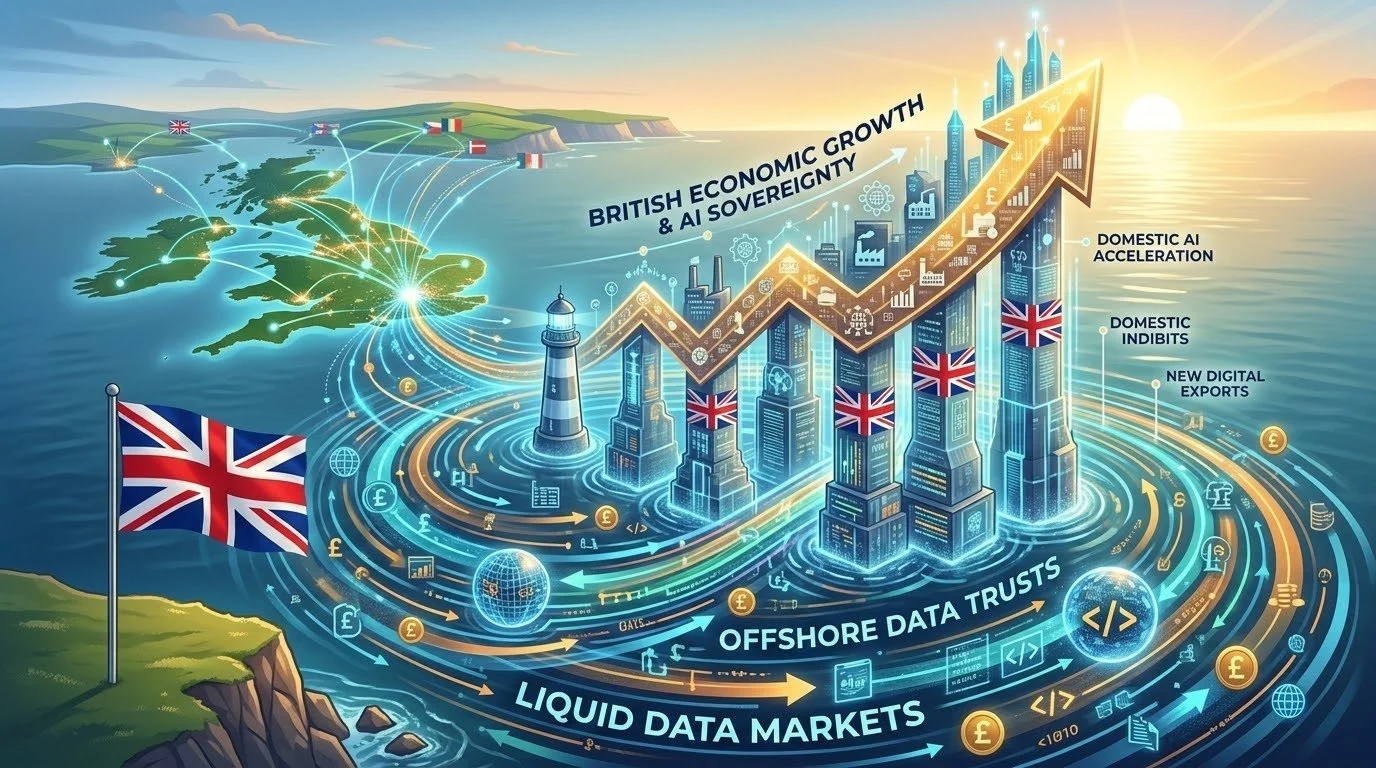
The CDOTs are zones of regulatory innovation, and this is precisely how they can help the UK in AI. The UK is a large, complex, and slow moving jurisdiction; the CDOTs are not. Using the smaller scale and nimble posture of the CDOTs, the UK can (a) experiment with data fiduciary laws it may later wish to roll out in the UK; (b) attract business from other countries, and (c ) improve its AI industry by improving data markets
The good news is that this is already happening. Two CDOT jurisdictions are already experimenting with data fiduciary laws.
Jersey: Jersey has passed a data trust law. Under this statute, data can be held and managed by trusts, opening up a range of new commercial and public policy opportunities.
The Isle of Man: The Isle of Man recently passed its Data Asset Foundation law, which means data can be treated as an asset class and owned/managed by data asset foundations
What strategic value does this provide to the UK?
Offshore data fiduciaries like those in Jersey and the Isle of Man can have several positive impacts:
Market-structural: a fiduciary standardises licensing terms, aggregates fragmented data into commercially useful pools, and gives smaller data generators better market access and bargaining power. This improves the ability of individual data generators to contribute and share data.
A boost to AI: Efforts to assetize data, such that in the Isle of Man, will directly help the amount of data available for AI training. So too will it give data holding organisations, and data-producing individuals, new revenue flows - licensable, revenue generating assets.
A data stewardship layer: The data fiduciaries can be directly integrated with DSITs smart data initiative work - a storage, stewardship, and fiduciary layer for the data now being opened up by real-time API access.
An export industry: No other jurisdictions have comparable data fiduciary structures, and they won't have them for some time. Within that time, the UK’s various could build up as an unbeatable data stewardship cluster. This provides an export opportunity - foreign data holders could use CDOT structures to hold their data assets. This will generate fees for the CDOTs, for UK service providers, and thus too for HMRC.
Data rights for individuals: Through aggregation, data fiduciaries give individually powerless data subjects more collective bargaining power. This, as outlined in the 2017+ data trusts discourse, could have a range of prosocial effects.
A place to experiment: The UK can use the offshore jurisdictions and places to experiment, see what is good, and then return the better ideas back to the mainland
A note on data fiduciaries and the AI stack
None of this functions unless it integrates with how AI developers actually handle data - entering at the edges of the existing stack rather than replacing it: at ingestion, where new products can build a trust in as the default data destination from the start; at the export edge, plugging into rails Smart Data already forces open; and as clean-room infrastructure, mediating access between parties without exposing raw data to either. But the operationally decisive entry point is likely to be at the point of use itself - a live, repeated draw at inference, not a one-off training-time copy. There, the fiduciary's core function is a permissioning and metering layer sitting in the request path: checking whether a licence is current and a use in scope, logging each access event, and feeding usage straight into royalty distribution. None of these components are exotic - data lineage tools, policy engines, and usage metering already exist elsewhere. What's new is using them to make a fiduciary's legal terms self-enforcing within the infrastructure itself.
What the UK should do
The UK should embrace the CDOTs as centres for tech innovation & regulatory experimentation. In particular it should:
Collaborate: Establish a standing DSIT/Jersey/Isle of Man liaison, focused on interoperability, and with explicit mandate to grow the data fiduciary sector as a financial and professional-services export
Build CDOT capacity: support Jersey and the Isle of Man, and other potential CDOT jurisdictions in building out the regulatory, judicial, and professional-services infrastructure needed for data fiduciaries
Identify and create pilots: in collaboration with the Isle of Man and Jersey. Ue this to develop capacity and prove use-cases.
Support export positioning: Position CDOT data fiduciary services explicitly as a UK-adjacent export line ; this will help UK in the long run
Encourage Commonwealth adoption: Utilise commonwealth ties to position CDOT jurisdiction and trusted and neutral spaces for data stewardship and assetization
CDOT data fiduciaries and UK AI sovereignty
Taken together, this essay is an argument for a particular kind of sovereignty - not sovereignty over chips or megawatts, where the UK is a distant third and unlikely to close the gap through domestic effort alone, but sovereignty over the legal and ontological layer that determines who owns data and on what terms it may be used. This is the sovereignty a middle power can actually secure: not by outbuilding the United States and China on compute, but by building the legal infrastructure, and using this to set standards around the world.
This will create wealth and influence for the UK - but the stakes go beyond the commercial. As AI increasingly substitutes for labour as a source of economic value, a purely wage-based claim on that value weakens for most people, at precisely the moment the tax base built on wages comes under similar pressure. A capital-like claim - a unit of beneficial interest in a structure that licenses someone's data and pays out royalties as it is used, structurally no different from a resource royalty trust or a music collecting society - does not depend on employment at all, and offers a plausible mechanism by which ordinary citizens retain an economic stake in the AI transition
Developing the fiduciary layer further now, on legal infrastructure that already exists in the Crown Dependencies and alongside the access rails DSIT is building through Smart Data, will give Britain firms access to more data, British citizens the ability to gain value from the data they generate, and it will create and a new professional-services export line. Because of the standards setting and infrastructural influence it could create, it can give the UK a degree of structural influence over the AI value chain that has nothing to do with owning computers or models - the two inputs on which Britain, as a distant third, cannot expect to compete directly. For a middle power facing an AI transition it cannot control through scale alone, the common law and the offshore acceleration zones of the CDOTs may be the most consequential levers it has left.